Radial Shockwave Therapy for Muscle Pain in Pembrokeshire
Persistent muscular pain or tenderness that isn't settling as expected?
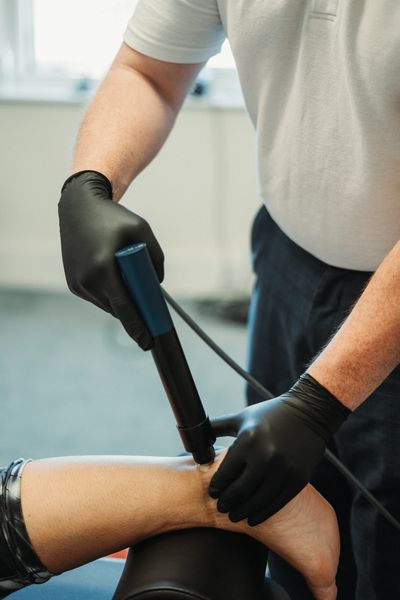
Radial shockwave therapy is a non-invasive treatment that delivers repeated mechanical pressure waves into the painful area through a handheld applicator.
At Tenby Health, we use radial shockwave for selected muscle-related problems, alongside appropriate advice, exercise or rehabilitation.
What is radial shockwave therapy?
Radial shockwave therapy, more technically known as radial pressure-wave therapy, uses a handheld device to deliver rapid mechanical pulses into the tissues.
The treatment acts over a relatively broad and superficial area, which makes it particularly useful for some muscle-related problems and areas of localised tenderness.
Although it is called “shockwave therapy”, radial shockwave works differently from focused shockwave therapy.
Treatment is non-invasive and usually takes only a few minutes.
What is radial shockwave best suited for?
Radial shockwave may be considered for problems such as:
- Persistent muscle pain
- Localised areas of muscular tenderness
- Painful or tender “knots” within a muscle
- Muscle tightness that has not settled with simple measures
- Some activity-related muscular pain
Research suggests that shockwave can help reduce pain for people suffering with muscle-related problems.
What does treatment feel like?
The applicator delivers a rapid series of pulses to the treatment area.
Most people describe this as a firm tapping or pulsing sensation.
Some areas can feel tender during treatment, particularly when the area is already sensitive, but the treatment intensity can be adjusted to a comfortable and tolerable level.
Radial shockwave vs focused shockwave - what’s the difference?
Radial and focused shockwave are not the same treatment.
Radial shockwave:
Radial shockwave spreads mechanical pressure waves over a broader area close to the surface.
At Tenby Health, we use it for selected muscle-related problems and areas of localised tenderness.
Focused shockwave allows energy to be directed more precisely to a specific depth. This makes it useful when we want to target a particular structure, such as a tendon.
At Tenby Health, focused shockwave is more commonly used for persistent tendon problems.
While both types of shockwave therapy utilise 'shock' waves, they serve different clinical purposes.
Radial Shockwave Therapy:
- Pressure waves disperse from the applicator, acting more superficially within soft tissues.
- This method is commonly used for treating muscular and myofascial conditions, providing muscle pain relief.
- It delivers lower energy to deeper structures and typically requires more sessions when addressing tendon problems.
Focused Shockwave Therapy:
- In contrast, energy is delivered with precision to a specific depth.
- It offers significantly higher energy directly into targeted tissues and penetrates deeper into tendons.
- Focused shockwave therapy is most frequently used for chronic tendon conditions and often requires fewer sessions, making it generally better tolerated.
- Usually more effective for stimulating tendon-specific healing responses compared to radial shockwave.
Consequently, we typically use radial shockwave for addressing muscular problems and focused shockwave for tackling tendon issues. Click here for more information on focused shockwave therapy.
Our approach
We don't start with shockwave. We start with the problem.
Before recommending treatment, we assess your symptoms, examine the affected area and consider the activities or loads that may be contributing to the pain.
Radial shockwave may then be used alongside:
- Advice on activity and load management
- Rehabilitation exercises
- Strengthening or mobility work
- Manual therapy
- Guidance on returning to normal activity or sport
Our aim is to choose treatment because it is appropriate for the problem we find, not simply because the technology is available.
Pricing
To ensure that radial shockwave therapy for muscle pain relief remains clinically effective and cost-efficient, we offer it in the following formats:
Initial introductory treatment (added to a New Patient consultation or follow-up appointment) – £30 (in addition to the appointment fee)
PAYG single session (dedicated radial shockwave therapy appointment for muscle pain relief, lasting 15 minutes) - £40
3-part package (three dedicated 15-minute appointments for shockwave therapy, targeting musculoskeletal conditions) – £110
What to do next
If persistent muscle pain, tightness or tenderness is affecting your activity or not improving as expected, book a New Patient consultation.
We will assess the problem, explain the most likely cause and discuss the treatment options that are appropriate for you.